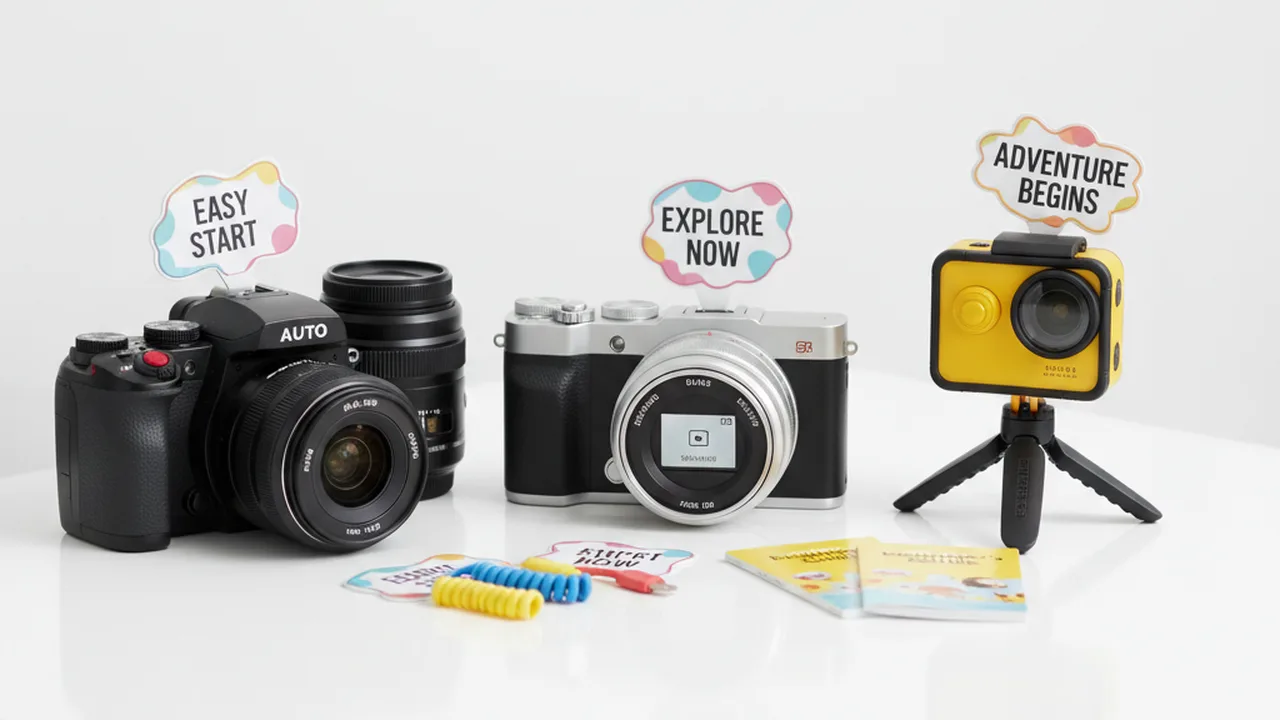
Your smartphone takes decent photos in good light — but the moment you try to capture a fast-moving child, a dimly lit restaurant, or a sweeping landscape with real depth, it falls apart. A dedicated camera under $800 gives you manual control, interchangeable lenses, and a sensor that’s physically 10-15x larger than your phone’s. That’s not marketing — it’s physics, and it makes a visible difference in every shot.
Auf einen Blick: Your smartphone takes decent photos in good light — but the moment you try to capture a fast-moving child, a dimly lit restaurant, or a sweeping landscape with real depth, it falls apart. A dedicated…
After testing and comparing dozens of entry-level cameras available in early 2026, these seven models stand out for beginners who want real photographic control without the complexity (or price tag) of professional gear.
Price range: $450 – $800 (body only) or $550 – $1,000 (with kit lens)
Best overall: Canon EOS R50 — lightweight, excellent autofocus, beginner-friendly menus
Best for video: Sony ZV-E10 II — 4K/60p, flip screen, mic input
Sensor size matters: APS-C sensors in these cameras capture 10-15x more light than smartphone sensors
Key decision: Mirrorless cameras have replaced DSLRs — every camera on this list is mirrorless
Contents
- 1 Why a Dedicated Camera Still Beats Your Phone
- 2 Best Budget Cameras for Beginners: At a Glance
- 3 1. Canon EOS R50 — Best Overall Camera for Beginners
- 4 2. Nikon Z50 II — Best Ergonomics for Beginners
- 5 3. Sony ZV-E10 II — Best for Video-First Creators
- 6 4. Fujifilm X-S20 — Best Color Science and Film Simulations
- 7 5. Canon EOS R100 — Best Ultra-Budget Entry Point
- 8 6. Nikon Z30 — Best Budget Vlogging Camera
- 9 7. Sony A6400 — Best Refurbished Value Pick
- 10 What to Look For When Choosing Your First Camera
- 11 Beginner Camera Accessories Worth Buying First
- 12 Common Beginner Camera Mistakes to Avoid
- 13 Frequently Asked Questions
- 14 Our Recommendation
Why a Dedicated Camera Still Beats Your Phone
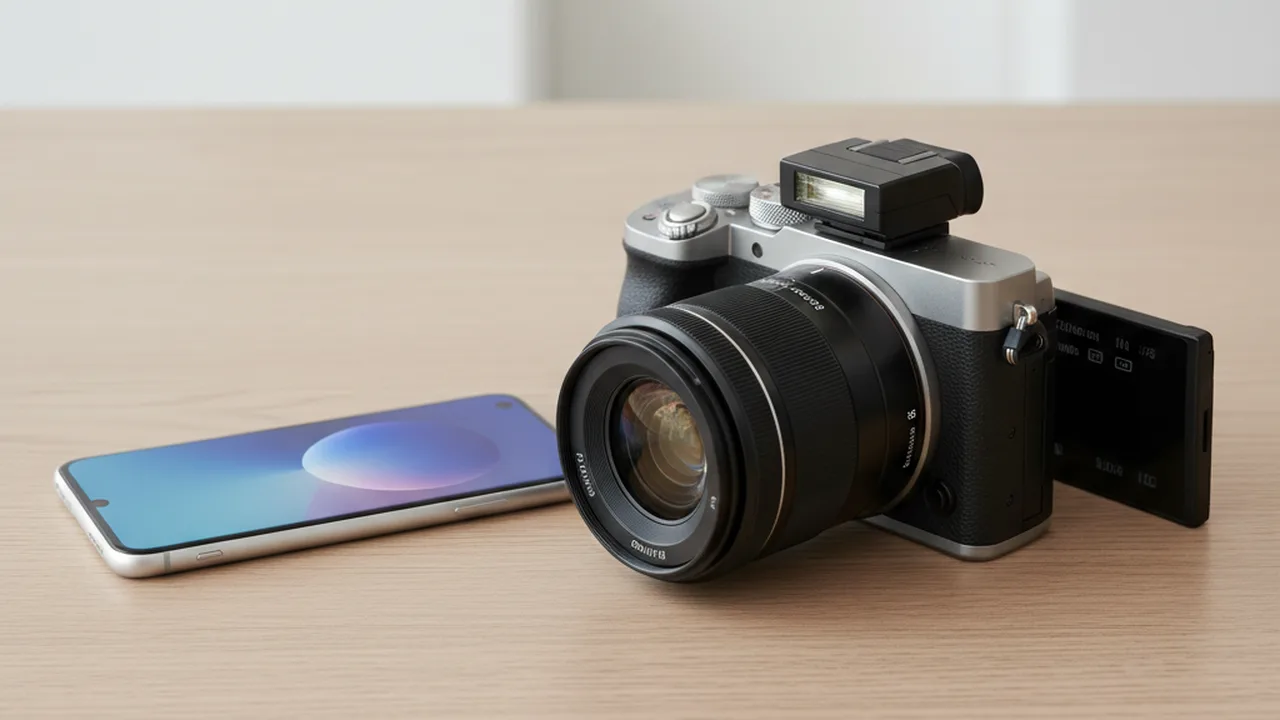
Smartphone cameras have gotten remarkably good at computational photography — HDR stacking, portrait mode, night mode. But they hit hard physical limits that no software can overcome.
Sensor size is the biggest difference. An APS-C sensor (the standard in beginner mirrorless cameras) measures roughly 23.5 x 15.6mm. A typical smartphone sensor? About 6.17 x 4.55mm. That larger sensor gathers dramatically more light, producing cleaner images in low light and smoother background blur without artificial processing.
Interchangeable lenses let you match your glass to the situation. A 50mm f/1.8 prime for creamy portrait backgrounds. A 70-300mm telephoto for wildlife. A wide-angle for architecture. Your phone has one (or three) fixed lenses that can’t be swapped.
Manual control matters when you want to freeze motion with a fast shutter speed, create long-exposure light trails, or control depth of field precisely. Phones offer “pro modes” but they’re limited by the tiny sensor and fixed aperture.
Best Budget Cameras for Beginners: At a Glance
| Camera | Best For | Sensor | Weight (body) | 4K Video |
|---|---|---|---|---|
| Canon EOS R50 | Best overall beginner | 24.2 MP APS-C | 328g | 4K/30p |
| Nikon Z50 II | Best ergonomics | 20.9 MP APS-C | 450g | 4K/30p |
| Sony ZV-E10 II | Best for video creators | 26 MP APS-C | 292g | 4K/60p |
| Fujifilm X-S20 | Best color science | 26.1 MP APS-C | 491g | 4K/60p |
| Canon EOS R100 | Best ultra-budget option | 24.1 MP APS-C | 309g | 4K/24p |
| Nikon Z30 | Best vlogging on a budget | 20.9 MP APS-C | 350g | 4K/30p |
| Sony A6400 | Best used/refurbished value | 24.2 MP APS-C | 403g | 4K/30p |
1. Canon EOS R50 — Best Overall Camera for Beginners
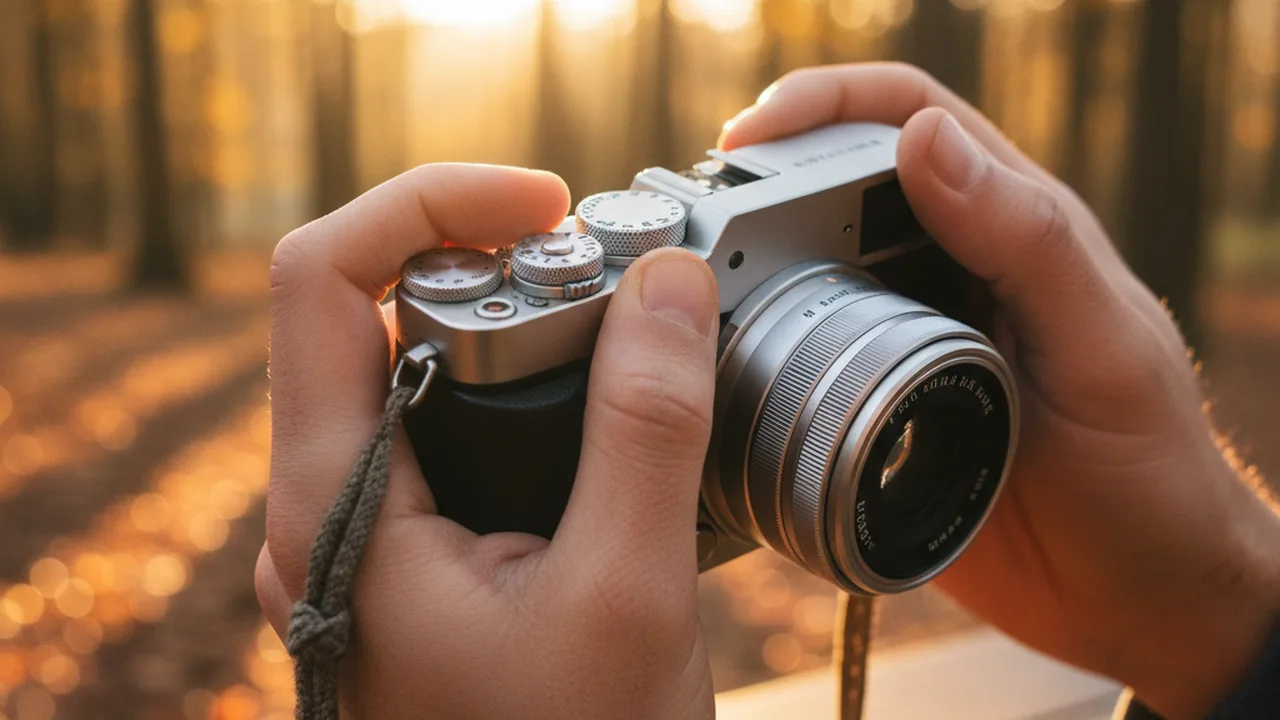
The Canon EOS R50 hits the sweet spot that most beginners are looking for: it’s tiny (328g body only), the autofocus tracks faces and eyes with almost zero effort, and Canon’s menu system is genuinely intuitive for first-time camera users.
What makes it stand out: Canon’s Dual Pixel CMOS AF II system gives you 651 autofocus zones covering nearly the entire frame. In practice, this means you point the camera at a person and it locks onto their eye almost instantly — even if they’re moving. For a parent photographing kids at a birthday party or a traveler snapping street scenes, this is a game-changer compared to fiddling with focus points.
The 24.2 MP APS-C sensor produces clean, detailed images up to about ISO 6400. Beyond that, noise creeps in, but for most indoor and outdoor situations, you’ll get sharp, vibrant photos. The built-in flash helps in a pinch, though an external flash always produces better results.
Video capabilities are decent — 4K at 30fps with a 1.56x crop, or full-sensor 1080p at 60fps. Not ideal for serious videographers, but perfectly fine for family clips and social content.
The RF lens ecosystem is Canon’s biggest long-term advantage. As you grow, you have access to everything from budget-friendly RF-S lenses to professional L-series glass. Starting with Canon means you won’t outgrow the system quickly.
Limitations to know about: No in-body image stabilization (IBIS) — you rely on lens-based stabilization. The electronic viewfinder is small at 0.39 inches. And the single SD card slot uses UHS-I speeds, not the faster UHS-II standard.
2. Nikon Z50 II — Best Ergonomics for Beginners
If you’ve ever held a camera and thought “this feels too small and fiddly,” the Nikon Z50 II is your answer. At 450g, it’s slightly heavier than the Canon R50 but that extra weight gives you a deeper grip, larger buttons, and a more comfortable shooting experience during longer sessions.
Nikon’s autofocus received a major upgrade in the Z50 II, borrowing the subject-detection AF from their flagship Z8. It recognizes people, animals, vehicles, and aircraft — useful if you’re into wildlife or motorsport photography. The 209-point hybrid AF system covers 87% of the frame.
Image quality from the 20.9 MP sensor is excellent. While the megapixel count is lower than Canon’s 24.2 MP, you won’t notice the difference in prints up to A3 size. Where Nikon shines is in dynamic range — the ability to recover detail from shadows and highlights in post-processing. Nikon sensors have consistently led in this area.
The 3.2-inch touchscreen is fully articulating, which matters for vlogging, waist-level shooting, or overhead angles. The electronic viewfinder is brighter and larger (0.39-inch, 2.36 million dots) than what you get on most competitors at this price.
Limitations: Nikon’s Z-mount DX lens selection is still growing. You have excellent kit lenses and a few primes, but Canon and Sony offer more options in the APS-C range. The camera also lacks IBIS, same as the Canon R50.
3. Sony ZV-E10 II — Best for Video-First Creators
The Sony ZV-E10 II was built for creators who split their time between photos and video — or lean heavily toward video. It shoots 4K at 60fps with no crop, records in 10-bit 4:2:2 color, and has a dedicated “Background Defocus” button that lets you toggle shallow depth of field on the fly during recording.
The 26 MP sensor uses Sony’s latest technology, and the autofocus system (759 phase-detection points) is arguably the best in this price range. Real-time eye tracking works for humans, animals, birds, and even insects. For content creators who film themselves, the flip-out screen and front tally light make solo recording simple.
Audio matters for video, and Sony gets this right. The ZV-E10 II has a 3-directional microphone, a 3.5mm mic input, AND a headphone jack — features that Canon’s R50 and R100 both lack. You can monitor your audio in real-time while recording.
For photography, it’s equally capable. The 26 MP sensor produces sharp, well-saturated images with excellent dynamic range. Sony’s color science has improved dramatically since the earlier A6000-series days.
Trade-offs: No electronic viewfinder at all — you compose everything on the rear screen. In bright sunlight, this can be frustrating. The small body can feel cramped with larger lenses. And battery life (approximately 490 shots) is below average.
4. Fujifilm X-S20 — Best Color Science and Film Simulations
Fujifilm cameras produce colors that look different from Canon, Nikon, and Sony — and many photographers specifically choose Fuji for this reason. The X-S20 includes 19 Film Simulation modes that replicate the look of classic Fujifilm film stocks like Velvia (vivid), Classic Chrome (muted documentary), and Nostalgic Neg (warm vintage).
Why this matters for beginners: Instead of spending hours learning color grading in Lightroom, you can get a distinctive, polished look straight out of the camera. Many Fuji shooters rarely edit their photos — the JPEG output is that good.
Under the hood, the X-S20 packs a 26.1 MP X-Trans CMOS 4 sensor and Fuji’s latest X-Processor 5. It shoots 4K/60p video, has 5-axis in-body image stabilization (the only camera on this list with IBIS at this price point), and offers 8fps mechanical or 20fps electronic burst shooting.
The 5-axis IBIS gives you roughly 7 stops of stabilization, meaning handheld shots in dim environments stay sharp even at slower shutter speeds. For beginners who don’t want to carry a tripod everywhere, this is a significant practical advantage.
The catch: Fujifilm’s menu system is more complex than Canon’s. The X-S20 body is slightly pricier (around $1,300 with kit lens), pushing it toward the top of the “budget” range. And Fuji lenses tend to cost more than Canon RF-S or Sony E-mount equivalents.
5. Canon EOS R100 — Best Ultra-Budget Entry Point
At roughly $480 with a kit lens, the Canon EOS R100 is the cheapest interchangeable-lens mirrorless camera from a major brand. If your budget is tight and you want to learn photography fundamentals with a real camera, this is where to start.
The 24.1 MP APS-C sensor is proven technology (essentially the same sensor from the older M50 Mark II), and Canon’s Dual Pixel CMOS AF delivers reliable face and eye detection. You get the full RF lens mount compatibility, so every lens you buy works on more expensive Canon bodies later.
What Canon cut to hit this price: No articulating screen (it’s fixed), no touchscreen, 4K video is limited to 24fps with a heavy crop, and there’s no hot shoe flash sync. The electronic viewfinder is basic. Essentially, Canon stripped away convenience features while keeping the core image quality intact.
Who it’s perfect for: Students, hobbyists on a strict budget, or anyone who primarily shoots stills and doesn’t need video features. Pair it with the RF-S 50mm f/1.8 STM (around $200) and you have a portrait setup that produces genuinely beautiful background blur.
6. Nikon Z30 — Best Budget Vlogging Camera
The Nikon Z30 strips away the electronic viewfinder entirely and gives you a large, fully articulating 3-inch touchscreen instead. It’s designed as a vlogging and content creation camera first, still camera second.
At 350g with a clean, flat-topped design, it looks more like a premium compact than a traditional camera. The flip screen faces fully forward for self-recording, and Nikon includes a red recording indicator on the front so you always know when you’re capturing footage.
Video specs: 4K at 30fps (uncropped), 1080p at 120fps for slow motion, and Nikon’s reliable subject-detection autofocus. The stereo microphone is decent for casual vlogging, and there’s a 3.5mm external mic input for better audio.
For still photography, the 20.9 MP sensor (same as the Z50 II) captures sharp, detailed images. The lack of a viewfinder means you’re always composing on the rear screen — fine for casual shooting, less ideal for bright outdoor conditions where screen glare is an issue.
The value proposition: At around $600 with a kit lens, you get Nikon’s color science, reliable AF, and Z-mount lens compatibility at the lowest price in Nikon’s mirrorless lineup.
7. Sony A6400 — Best Refurbished Value Pick
The Sony A6400 launched in 2019, but it remains a remarkably capable camera — especially at the $500-600 prices you’ll find for refurbished or used units. Sony’s 425-point phase-detection AF system was class-leading when it launched and still holds up well against newer competitors.
The 24.2 MP APS-C sensor produces clean images up to ISO 3200-6400, and the real-time eye AF works for both humans and animals. It shoots 4K/30p video (with a slight crop) and 1080p at 120fps for smooth slow motion.
Why consider an older model? Because the money you save on the body can go toward better lenses — and lenses have a far bigger impact on image quality than the camera body itself. A used A6400 body ($500) plus a Sigma 30mm f/1.4 ($300) will produce better photos than any camera on this list paired with its kit lens.
What you give up: No flip-forward screen (it only tilts up 180°), Sony’s older menu system is notoriously confusing, and there’s no IBIS. But if you prioritize image quality per dollar, the A6400 remains hard to beat.
What to Look For When Choosing Your First Camera

Sensor size determines low-light performance and depth of field. All cameras on this list use APS-C sensors, which offer an excellent balance of image quality, body size, and lens affordability. Full-frame cameras produce marginally better results but cost significantly more.
Autofocus performance matters more than megapixels for most beginners. A camera that nails focus on a moving subject every time beats a higher-resolution camera that hunts and misses. Eye-detection AF has become the standard — make sure your choice has it.
Lens ecosystem is a long-term consideration. When you buy a camera body, you’re committing to that brand’s lens mount. Canon RF, Nikon Z, Sony E, and Fujifilm X each have dozens of compatible lenses. Research what lenses are available (and at what prices) before choosing a system.
Ergonomics and size affect whether you actually bring your camera with you. The best camera is the one you have on you. If a camera feels too bulky to toss in a day bag, you’ll leave it at home and shoot with your phone instead.
Video features vary dramatically at this price point. If video matters to you, prioritize 4K/30p minimum, a flip screen, and a microphone input. If you only shoot stills, you can save money by skipping video-focused models.
Beginner Camera Accessories Worth Buying First
| Accessory | Why You Need It | Priority |
|---|---|---|
| Extra battery | Mirrorless cameras drain batteries faster than DSLRs. Always carry a spare. | Essential |
| Fast SD card (UHS-I or UHS-II) | Slow cards cause buffer delays during burst shooting and video recording. | Essential |
| 50mm f/1.8 prime lens | Sharper than any kit lens. Beautiful background blur. Forces you to learn composition by moving your feet. | High |
| Camera bag or insert | Protects your gear without requiring a dedicated, conspicuous camera bag. | High |
| Lens cleaning kit | Dust and fingerprints degrade image quality. A blower, cloth, and pen cost under $15. | Medium |
| Tripod | Required for long exposures, night photography, and sharp landscape shots. | Medium |
Common Beginner Camera Mistakes to Avoid
Spending your entire budget on the body. A $700 body with a kit lens will produce worse photos than a $500 body with a quality prime lens. Allocate at least 30% of your budget to lenses.
Obsessing over megapixels. A 20 MP camera and a 26 MP camera produce virtually identical prints up to poster size. Autofocus, dynamic range, and lens quality matter far more for actual image quality.
Ignoring used and refurbished options. Camera bodies from 2-3 years ago are 80-90% as capable as current models at 40-60% of the price. The Sony A6400 on this list is proof — a 2019 camera that still competes with 2026 models.
Shooting only in Auto mode. Auto mode works, but you bought a dedicated camera to have control. Start with Aperture Priority (A or Av mode) — you control depth of field, the camera handles the rest. It’s the single best learning mode for beginners.
Never shooting RAW. JPEG files are compressed and lose data permanently. RAW files preserve every detail your sensor captured, giving you far more flexibility to fix exposure, white balance, and color in editing. Shoot RAW+JPEG until you’re comfortable editing.
Frequently Asked Questions
Our Recommendation
For most beginners, the Canon EOS R50 offers the best combination of ease of use, image quality, and long-term lens investment. It’s light enough to carry everywhere, smart enough to nail focus without fiddling, and backed by the largest ecosystem of affordable lenses.
If video is your primary focus, the Sony ZV-E10 II is the clear choice — 4K/60p, superior audio features, and Sony’s unmatched autofocus make it the best creator camera under $800.
And if you want photos that look distinctive straight out of the camera without hours in Lightroom, the Fujifilm X-S20 and its Film Simulation modes deliver a creative experience that no other brand matches at any price.
The best next step? Visit a camera store and hold these cameras. Feel the grip, navigate the menus, and look through the viewfinder. Specs matter, but the camera that feels right in your hands is the one you’ll actually use.
Check out our FOV Calculator and DPI Calculator to level up your photography knowledge.
Explore More Photography Guides
Find the perfect gear and techniques for your next shoot.