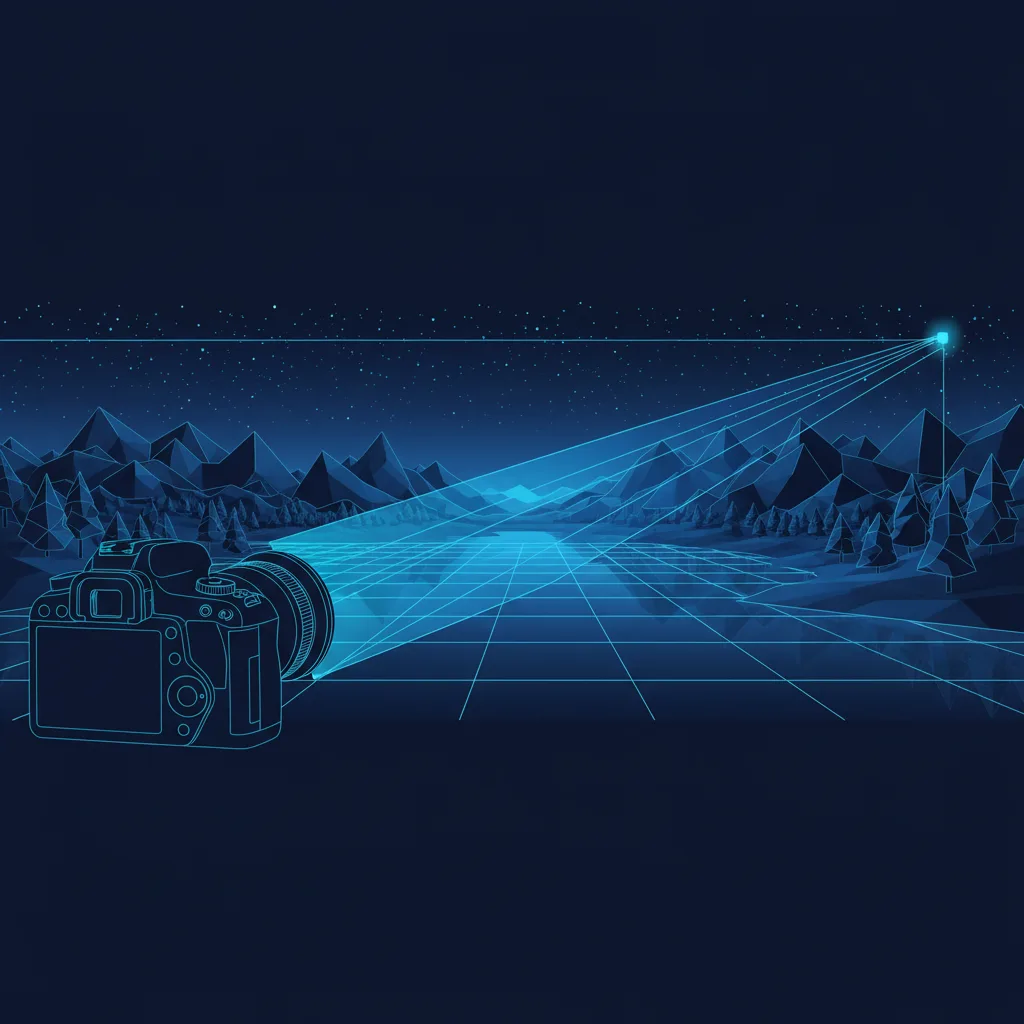
This Field of View (FOV) Calculator shows you exactly how much of a scene your camera captures with any lens and sensor combination. Enter your focal length, pick your sensor size, set the subject distance, and get precise horizontal, vertical, and diagonal FOV angles — plus the physical frame dimensions at that distance. No guessing, no math.
Use the lens's actual focal length and the sensor dimensions used for the shot.
Angle of view
Calculating…
Approximate scene width × height:
Rectilinear thin-lens estimate: angle = 2 × arctan(sensor dimension ÷ (2 × focal length)). Close focus, focus breathing, distortion, and in-camera crop modes can change the actual framing.
What Is Field of View in Photography?
Field of view is the angular area your lens projects onto the sensor. It’s measured in degrees — horizontally, vertically, and diagonally. A Canon RF 16mm f/2.8 on a full-frame body covers about 108° diagonally. Mount a Canon RF 200mm f/2.8 and that shrinks to roughly 12°.
FOV isn’t just an abstract number. It determines whether you can fit an entire building in the frame from across the street, or whether you’ll need to back up 50 meters. It tells you if your 85mm portrait lens will frame a headshot or a full body at 3 meters.
Two variables control FOV: focal length and sensor size. Shorter focal lengths widen the view. Larger sensors widen it further. That’s why the same 50mm lens sees less on a Fujifilm X-T5 (APS-C, 1.5× crop) than on a Sony A7 IV (full frame).
How to Use This Calculator
Step 1: Select your sensor format — Full Frame (36×24mm), APS-C (23.5×15.6mm), Micro Four Thirds (17.3×13mm), Medium Format (43.8×32.9mm), or enter custom dimensions for specialty sensors.
Step 2: Enter your lens focal length in millimeters. Use the actual focal length printed on the lens, not the “equivalent” — the calculator handles crop factor automatically.
Step 3: Set the distance to your subject. The calculator then outputs your FOV angles and the exact width × height of the area captured at that distance.
How Focal Length Affects Field of View
The relationship between focal length and FOV is not linear — it follows an inverse tangent curve. Going from 24mm to 50mm on full frame cuts your horizontal FOV nearly in half (from ~74° to ~40°). But going from 200mm to 400mm only reduces it from ~10° to ~5°. The widest gains happen at short focal lengths.
Here’s a reference for full-frame (36×24mm) sensors:
| Focal Length | Horizontal FOV | Vertical FOV | Diagonal FOV | Typical Use |
|---|---|---|---|---|
| 14mm | 104° | 81° | 114° | Ultra-wide landscape, astrophotography |
| 24mm | 74° | 53° | 84° | Wide landscape, architecture, vlogging |
| 35mm | 54° | 38° | 63° | Street, documentary, environmental portrait |
| 50mm | 40° | 27° | 47° | Standard, portrait, everyday |
| 85mm | 24° | 16° | 29° | Portrait, headshot |
| 135mm | 15° | 10° | 18° | Compressed portrait, sports |
| 200mm | 10° | 7° | 12° | Wildlife, birding, distant sports |
Sensor Size Comparison: Why It Matters
A Sony FE 50mm f/1.8 on a full-frame A7C II gives ~40° horizontal FOV. Mount the same focal length on a Sony A6700 (APS-C, 1.5× crop) and it narrows to ~27° — the equivalent framing of a 75mm on full frame. On a Panasonic GH7 (Micro Four Thirds, 2× crop), that 50mm behaves like 100mm with only ~20° horizontal FOV.
| Sensor Format | Dimensions (mm) | Crop Factor | 50mm Equiv. FL | 50mm Horiz. FOV |
|---|---|---|---|---|
| Medium Format (Fuji GFX) | 43.8 × 32.9 | 0.79× | ~39mm | ~47° |
| Full Frame (35mm) | 36 × 24 | 1.0× | 50mm | ~40° |
| APS-C (Canon) | 22.3 × 14.9 | 1.6× | ~80mm | ~25° |
| APS-C (Sony/Nikon/Fuji) | 23.5 × 15.6 | 1.5× | ~75mm | ~27° |
| Micro Four Thirds | 17.3 × 13 | 2.0× | ~100mm | ~20° |
| 1-inch (Sony RX100) | 13.2 × 8.8 | 2.7× | ~135mm | ~15° |
Popular Lenses to Explore Different Fields of View
Now that you understand how focal length affects FOV, here are some top-rated lenses across different focal lengths to experiment with:
Ultra-Wide Lenses (14-24mm)
For dramatic landscapes, astrophotography, and architecture. These lenses capture the widest possible FOV.
- Canon RF 24-70mm f/2.8 L IS USM — Professional zoom covering wide to standard range with exceptional sharpness.
Standard Zoom Lenses (24-70mm)
The most versatile range for everyday shooting — from environmental portraits to travel photography.
- Sony FE 24-70mm f/2.8 GM II — Sony’s flagship standard zoom. Lightweight, razor-sharp, and fast autofocus.
- Nikon NIKKOR Z 24-70mm f/2.8 S — Nikon’s best standard zoom for Z-mount. Outstanding optical performance.
Telephoto Lenses (70-200mm)
Narrow the FOV for portraits, sports, and wildlife. These focal lengths compress backgrounds beautifully.
- Sony FE 70-200mm f/2.8 GM II — The lightest 70-200 f/2.8 available. Superb for portraits and events.
- Canon RF 70-200mm f/2.8 L IS USM — Canon’s compact telephoto zoom with built-in IS. A game-changer for handheld shooting.
- Nikon AF-S 70-200mm f/2.8E FL ED VR — Nikon’s legendary F-mount telephoto. Still one of the sharpest zooms ever made.
Super-Telephoto for Wildlife & Birding
When you need extreme reach with minimal FOV to isolate distant subjects.
- Canon EF 70-200mm f/2.8L IS III USM — Rock-solid image quality with weather sealing for field work.
Prime Lenses for Sharpest FOV
Prime lenses deliver the sharpest results at any given focal length — ideal for testing and understanding your exact field of view. With no zoom range to worry about, you get predictable framing every time.
- Canon RF 50mm f/1.8 STM — The best-value 50mm for Canon mirrorless. Gives ~40° horizontal FOV on full frame. At $199, it’s the easiest way to explore standard focal length shooting with creamy f/1.8 bokeh.
- Sony FE 50mm f/1.8 — Sony’s affordable nifty fifty for E-mount. Same ~40° horizontal FOV on full-frame A7 bodies, or ~27° on APS-C (equivalent to 75mm framing). Lightweight at just 186g.
- Nikon NIKKOR Z 50mm f/1.8 S — Nikon’s premium Z-mount 50mm prime. Optically superior to the Canon and Sony budget fifties, with near-zero distortion and outstanding corner sharpness. Worth the price jump for serious shooters.
Recommended Camera Bodies to Pair With These Lenses
To get the most from the FOV calculator, pair your lens choice with a body that matches your intended sensor size:
- Sony A7C II (Full Frame) — Compact full-frame mirrorless with 33MP sensor. The smallest body to get the full 36×24mm sensor FOV from any E-mount lens. Ideal for travel photographers who want full-frame angles without the bulk.
- Canon EOS R8 (Full Frame) — Canon’s lightest full-frame RF-mount body. 24.2MP with outstanding autofocus. Pair it with the RF 50mm f/1.8 above for a sub-$1500 full-frame kit that delivers true full-frame FOV.
- Fujifilm X-T5 (APS-C) — 40MP APS-C body with 1.5× crop factor. Every lens you mount delivers a tighter FOV than full frame — use the calculator above to see exactly how much. Outstanding image quality that rivals full-frame at a fraction of the weight.
Telescopes & Binoculars
FOV isn’t just for cameras — telescopes and binoculars also have defined fields of view. Use the calculator above with telescope focal lengths to understand what you’ll see through the eyepiece.
- Celestron NexStar 8SE Telescope — A popular computerized telescope for astronomy. Use its 2032mm focal length in our calculator to see the narrow FOV needed for planetary observation.
- Nikon Monarch M5 Binoculars — Excellent all-purpose binoculars for birding and wildlife observation. Compact, bright optics with wide apparent FOV.
Counterintuitive tip: APS-C shooters often think they’re “missing out” on wide angles. In reality, an Olympus/OM System 7-14mm f/2.8 PRO on Micro Four Thirds delivers a 14-28mm equivalent FOV with weather sealing and compact size that no full-frame 14mm can match for backpacking weight.
FOV for Common Photography Scenarios
Landscape photography typically demands 14-35mm (full-frame equivalent). The Nikon Z 14-30mm f/4 S covers 114° to 63° diagonally — enough to sweep an entire mountain range or narrow down to a specific ridge. At 14mm, standing on a cliff edge, you’ll capture roughly 18 meters of horizontal ground at just 10 meters distance.
Portrait photography works best between 85-135mm on full frame. The Sony FE 85mm f/1.4 GM gives about 24° horizontal FOV. At 2.5 meters from your subject, that frames a head-and-shoulders shot covering roughly 1.1 meters wide — flattering compression without standing absurdly far away.
Wildlife and birding requires 200-600mm. A Sigma 150-600mm f/5-6.3 on a Nikon Z8 at 600mm delivers just 3.4° horizontal FOV. At 30 meters, your frame covers only 1.8 meters wide — enough to isolate a heron from a busy wetland.
Architecture and real estate leans on 16-24mm. The Canon RF 15-35mm f/2.8L at 15mm captures ~100° diagonally. That’s wide enough to photograph an entire hotel room from the doorway, covering about 7 meters of wall-to-wall space at 3 meters distance.
Practical FOV Examples with Real Lenses
The Tamron 28-75mm f/2.8 Di III VXD G2 (Sony E-mount, full frame) ranges from 65° diagonal at 28mm down to 32° at 75mm. At a wedding reception, 28mm lets you capture a full table of 8 guests from 2 meters. Zoom to 75mm and you isolate a couple dancing from across the room at 8 meters.
The Fujifilm XF 56mm f/1.2 R WR on an X-T5 (APS-C) gives the same FOV as an 84mm on full frame — about 24° horizontal. Perfect for tight portraits, but you’ll struggle to fit a group of four at anything closer than 4 meters.
Shooting video? The Sony FE 24-70mm f/2.8 GM II at 24mm on an A7S III gives ~74° horizontal. Ideal for B-roll walkthroughs. But enable Sony’s Active SteadyShot and the frame crops by ~1.1×, reducing your effective FOV to about 67° — effectively a 26mm view. Factor that into your planning.
Practical Tips
Pre-scout with your phone. Most smartphone main cameras are ~26mm equivalent (roughly 72° diagonal). If a scene fills your phone screen edge to edge, you’ll need at least a 24mm lens on full frame to match it.
Don’t trust “equivalent focal lengths” blindly. A 50mm f/1.8 on APS-C gives the same FOV as 75mm on full frame, but the depth of field stays that of a 50mm. You get tighter framing without the background blur of a true 75mm on full frame. That’s a real difference for portraits.
Panorama stitching changes everything. A 6-shot panorama at 50mm covers far more than a single 24mm frame — with dramatically higher resolution. If you have a tripod and a static scene, a longer lens plus stitching beats an ultra-wide for landscape detail.
VR/360 shooters: The Insta360 X4 uses two 180°+ lenses stitched together. But the “usable” FOV (without visible stitching artifacts) is closer to 340°. Always check your stitching zone before committing to a setup for live events.
Related Lens Guides
Choosing the right lens directly affects your field of view. Explore our in-depth lens guides for specific shooting scenarios:
- Best Lenses For Landscape Photography
- Best Lenses For Wildlife Photography
- Best Lenses For Street Photography
- Best Portrait Lenses
- Shooting Macro With A Regular Lens
- Best Astrophotography Lenses
FAQ — Frequently Asked Questions
What is the field of view of a 50mm lens?
On a full-frame sensor: ~40° horizontal, ~27° vertical, ~47° diagonal. On APS-C (1.5× crop): ~27° horizontal. On Micro Four Thirds: ~20° horizontal. The 50mm focal length only tells half the story — sensor size completes it.
How do I calculate field of view manually?
The formula is: FOV = 2 × arctan(sensor dimension / (2 × focal length)). For horizontal FOV on full frame with a 35mm lens: 2 × arctan(36 / 70) = 2 × arctan(0.514) ≈ 54°. Or just use the calculator above.
Does a teleconverter change FOV?
Yes. A 1.4× teleconverter on a 200mm lens makes it 280mm, narrowing horizontal FOV from ~10° to ~7° on full frame. A 2× converter doubles the focal length, halving the FOV — but you lose 1-2 stops of light and some autofocus speed.
Is FOV the same as angle of view?
They’re used interchangeably in photography. Technically, “angle of view” refers to the lens property, while “field of view” describes the area covered at a specific distance. In practice, photographers mean the same thing.
Why does my wide-angle lens distort edges?
Rectilinear wide-angle lenses (like the Sigma 14-24mm f/2.8 DG DN Art) stretch objects near the edges to keep straight lines straight. Fisheye lenses avoid this by allowing barrel distortion. If edge distortion bothers you, keep subjects centered or switch to a moderate wide (24-28mm) instead of ultra-wide.
How does focus distance affect FOV?
At typical shooting distances, it doesn’t. But with macro lenses focused at minimum distance, the effective focal length increases (focus breathing), slightly narrowing FOV. The Nikon Z MC 105mm f/2.8 VR S at 1:1 macro behaves closer to ~130mm for FOV purposes.
Related Tools
Planning a print from your shoot? Use our DPI Calculator to find the maximum print size for your camera’s resolution at any quality level.