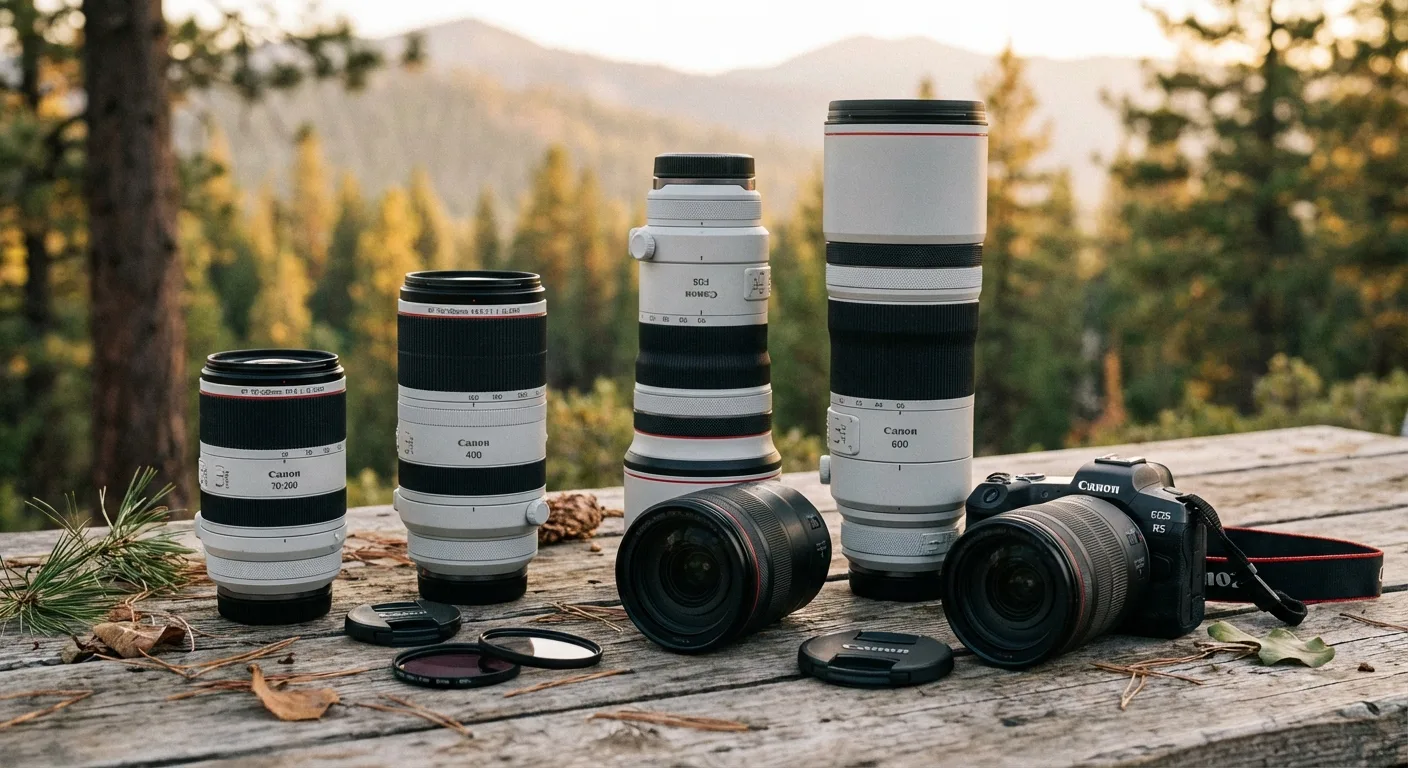
Canon’s RF mount has completely reshaped the telephoto lens landscape. Lighter bodies, faster autofocus, and optical designs that weren’t possible on EF mount — the RF system gives wildlife, sports, and portrait shooters more reach for less money than ever before.
I’ve spent hundreds of hours shooting with Canon RF telephoto lenses across bird photography, motorsports, and portraits. Here are the six best options ranked by value, performance, and real-world usability.
Contents
- 1 Quick Comparison Table
- 2 Canon RF 100-400mm f/5.6-8 IS USM — Best Budget Telephoto
- 3 Canon RF 600mm f/11 IS STM — The Gateway to Super-Telephoto
- 4 Canon RF 70-200mm f/2.8L IS USM — The Portrait and Event Workhorse
- 5 Canon RF 100-500mm f/4.5-7.1L IS USM — Best All-Around Telephoto
- 6 Canon RF 200-800mm f/6.3-9 IS USM — Maximum Reach
- 7 Canon RF 600mm f/4L IS USM — The Professional Choice
- 8 How to Choose the Right Canon RF Telephoto
- 9 Compatible Canon Bodies Worth Considering
- 10 FAQ
- 11 Final Thoughts
Quick Comparison Table
| Lens | Focal Range | Max Aperture | Weight | Best For | Price Range |
|---|---|---|---|---|---|
| Canon RF 100-400mm f/5.6-8 | 100-400mm | f/5.6-8 | 635g | Best budget telephoto | ~$650 |
| Canon RF 600mm f/11 IS STM | 600mm | f/11 (fixed) | 930g | Cheapest super-telephoto | ~$700 |
| Canon RF 70-200mm f/2.8L IS USM | 70-200mm | f/2.8 | 1,070g | Portraits & events | ~$2,700 |
| Canon RF 100-500mm f/4.5-7.1L IS USM | 100-500mm | f/4.5-7.1 | 1,370g | Best all-rounder | ~$2,800 |
| Canon RF 200-800mm f/6.3-9 IS USM | 200-800mm | f/6.3-9 | 2,050g | Maximum reach | ~$1,900 |
| Canon RF 600mm f/4L IS USM | 600mm | f/4 | 3,090g | Professional wildlife | ~$13,000 |
Canon RF 100-400mm f/5.6-8 IS USM — Best Budget Telephoto
The Canon RF 100-400mm f/5.6-8 is the lens that makes telephoto photography accessible. At roughly 635 grams, it weighs less than most 70-200mm zooms from the EF era. Pair it with an EOS R7 or R10 and the effective reach hits 640mm — enough for serious bird photography.
Sharpness impresses across the frame, particularly between 100-300mm. At 400mm and f/8, there’s slight softness in the corners, but center sharpness stays strong. The 5.5-stop optical IS works well enough to handhold at 400mm down to about 1/100s in good light.
Who it’s for: Birders and wildlife shooters on a budget. Travel photographers who want reach without bulk. APS-C shooters who want maximum effective focal length.
The catch: That f/8 maximum aperture at 400mm means you need good light. Indoor sports? Forget it. Overcast days in the forest? Expect ISO 6400+ on an R6 II. Autofocus also slows noticeably in low light compared to L-series glass.
Canon RF 600mm f/11 IS STM — The Gateway to Super-Telephoto
The Canon RF 600mm f/11 breaks every convention in telephoto lens design. A fixed f/11 aperture, a collapsing barrel, and a price tag under $700. Canon designed this specifically for EOS R’s Dual Pixel AF, which tracks reliably even at f/11 — something no DSLR could match.
At 600mm on an R7, you’re looking at 960mm equivalent. That’s birding-scope territory in a package that fits in a daypack. Optical quality is surprisingly good: sharp in the center with controlled chromatic aberration. The diffractive optics element (DO) keeps the whole lens compact.
Who it’s for: Birders and plane spotters who shoot in daylight. Beginners who want to experiment with super-telephoto on a budget.
The catch: Fixed f/11 means you’re locked into bright conditions. Background blur (bokeh) at f/11 is minimal unless your subject is very far from the background. The STM autofocus motor is adequate but noticeably slower than Nano USM — fast-moving birds in flight will test its limits.
Canon RF 70-200mm f/2.8L IS USM — The Portrait and Event Workhorse
The Canon RF 70-200mm f/2.8L shocked photographers when Canon announced its extending barrel design. Every previous 70-200mm f/2.8 from Canon used an internal zoom. The payoff? This lens collapses to just 146mm — about 30% shorter than its EF predecessor when stowed.
Image quality is, frankly, extraordinary. Corner-to-corner sharpness at f/2.8 matches what the EF version delivered stopped down to f/4. Dual Nano USM autofocus locks on eyes instantly, and the 5-stop IS keeps handheld shooting viable even at 200mm in dim reception halls.
Who it’s for: Wedding and event photographers. Portrait shooters who want creamy bokeh with tack-sharp eyes. Sports photographers working in controlled environments (basketball, volleyball).
The catch: At roughly $2,700, it’s a significant investment. The extending barrel worried early adopters about weather sealing — Canon insists it’s fully sealed, and thousands of pro shooters in rain and dust have confirmed it holds up.
Canon RF 100-500mm f/4.5-7.1L IS USM — Best All-Around Telephoto
Ask ten wildlife photographers what single RF telephoto they’d pick, and at least seven will name the Canon RF 100-500mm f/4.5-7.1L. It replaced the legendary EF 100-400mm L II and added 100mm of reach without a dramatic size increase.
The zoom range is the real story. Starting at 100mm means you can use it for tight portraits or environmental wildlife shots. At 500mm, you’re getting into serious super-telephoto territory. With a 1.4x extender (sold separately), you hit 700mm at f/10 — still within the R5 II’s phase-detect AF range.
Sharpness stays excellent through 400mm. At 500mm there’s a slight drop, but it’s still sharper than most third-party options. The L-series build quality includes full weather sealing, a lock switch for the zoom ring, and buttery-smooth zoom action.
Who it’s for: Serious wildlife and bird photographers who want one lens to cover everything. Sports shooters covering outdoor events. Anyone upgrading from the EF 100-400mm L II.
The catch: At 1,370g, it’s not light. Full-day handheld birding sessions will fatigue your arms by late afternoon. And at f/7.1 at 500mm, you’ll push ISO higher than you’d like in forests or overcast conditions.
Canon RF 200-800mm f/6.3-9 IS USM — Maximum Reach
The Canon RF 200-800mm delivers a zoom range that would have required a $12,000+ prime just a decade ago. At 800mm on a full-frame body — or an absurd 1,280mm equivalent on an R7 — you can photograph the moon’s craters handheld.
Canon priced this aggressively at roughly $1,900, making it the cheapest way to reach 800mm with autofocus. The trade-off is the f/9 maximum aperture at 800mm, which limits you to bright outdoor conditions. But for birders and wildlife photographers who shoot during golden hour and daylight, it opens up compositions that were simply impossible before.
Who it’s for: Bird photographers who need extreme reach. Airshow and aviation enthusiasts. Safari shooters who want to fill the frame with distant subjects.
The catch: At 2,050g and 314mm collapsed length, this is a big lens. The f/9 aperture at 800mm requires strong light — expect ISO 3200+ even on sunny days if your shutter speed needs to freeze motion.
Canon RF 600mm f/4L IS USM — The Professional Choice
At roughly $13,000, the Canon RF 600mm f/4L sits in a different category entirely. This is the lens you see on the sidelines of the Super Bowl and at Olympic track events. The f/4 aperture at 600mm delivers buttery bokeh that separates subjects from backgrounds in a way no variable-aperture zoom can match.
Optical quality is essentially perfect — razor sharp across the frame wide open, with Canon’s fluorite and Super UD elements eliminating chromatic aberration. Autofocus tracks at speeds that feel telepathic.
Who it’s for: Working professional wildlife and sports photographers whose income depends on capturing sharp images in challenging light.
The catch: The price. And at 3,090g (6.8 pounds), it demands a monopod or gimbal head for extended shooting.
How to Choose the Right Canon RF Telephoto
Picking the right telephoto depends on three things: your subjects, your light, and your budget.
Shooting in good light outdoors? The RF 100-400mm or RF 200-800mm give you tremendous reach per dollar. The 100-400mm weighs almost nothing; the 200-800mm reaches distances that seem almost unfair.
Need low-light performance? Only the RF 70-200mm f/2.8L and the RF 600mm f/4L offer apertures wide enough for indoor sports, dusk wildlife, or dimly-lit events.
Want one lens to do everything? The RF 100-500mm f/4.5-7.1L is the answer. It handles portraits at 100mm, wildlife at 500mm, and everything between.
On a strict budget? Start with the RF 100-400mm. Paired with an R7 crop body, the effective 640mm reach rivals setups costing five times more.
Compatible Canon Bodies Worth Considering
These RF telephoto lenses pair particularly well with:
- Canon EOS R5 II — 45MP, blazing AF with eye detection, 8K video. The flagship for wildlife stills.
- Canon EOS R7 — 1.6x crop sensor multiplies your reach. 15fps mechanical shutter. Best value for bird photography.
- Canon EOS R6 III — Excellent low-light ISO performance. Ideal for forests and dusk shooting.
- Canon EOS R10 — Budget crop body with Canon’s Dual Pixel AF II. Great starter for telephoto work.
FAQ
What is the best budget telephoto lens for Canon RF mount?
The Canon RF 100-400mm f/5.6-8 IS USM offers the best value at roughly $650. It delivers sharp images with reliable autofocus and 5.5-stop stabilization. Pair it with an R7 for 640mm equivalent reach.
Can I use Canon EF telephoto lenses on RF mount cameras?
Yes, with the Canon EF-RF adapter. EF lenses work with full autofocus and stabilization on RF bodies. Many photographers use the EF 100-400mm L II on R5 and R7 bodies with excellent results.
Is the Canon RF 200-800mm worth buying?
For daylight wildlife and bird photography, absolutely. No other lens delivers 800mm autofocus reach at this price point. The main limitation is the f/9 aperture at 800mm, which restricts you to bright conditions.
Which Canon RF lens is best for bird photography?
The RF 100-500mm f/4.5-7.1L IS USM is the most popular choice among serious birders. It balances reach, image quality, and autofocus speed better than anything else in the lineup. Budget-conscious birders should consider the RF 100-400mm on a crop body.
Do Canon RF telephoto lenses work with teleconverters?
Only L-series RF lenses support Canon’s RF 1.4x and 2x extenders. The RF 100-500mm, RF 600mm f/4L, and RF 70-200mm f/2.8L are compatible. Budget lenses like the RF 100-400mm and RF 600mm f/11 are not.
Final Thoughts
Canon’s RF telephoto lineup covers every budget and shooting scenario. The gap between “budget” and “professional” optics has never been smaller — a $650 RF 100-400mm on an R7 produces images that would have required $5,000+ in glass just eight years ago.
Start with the lens that matches your light conditions and subjects. Upgrade when your photography demands it, not when gear acquisition syndrome whispers in your ear.
Looking for more lens guides? Check out our Best Telephoto Lenses for Canon DSLR guide, or explore the Best Lenses for Sony A7 IV if you’re comparing systems. For wildlife-specific camera recommendations, see our Best Sony Camera for Wildlife Photography guide.