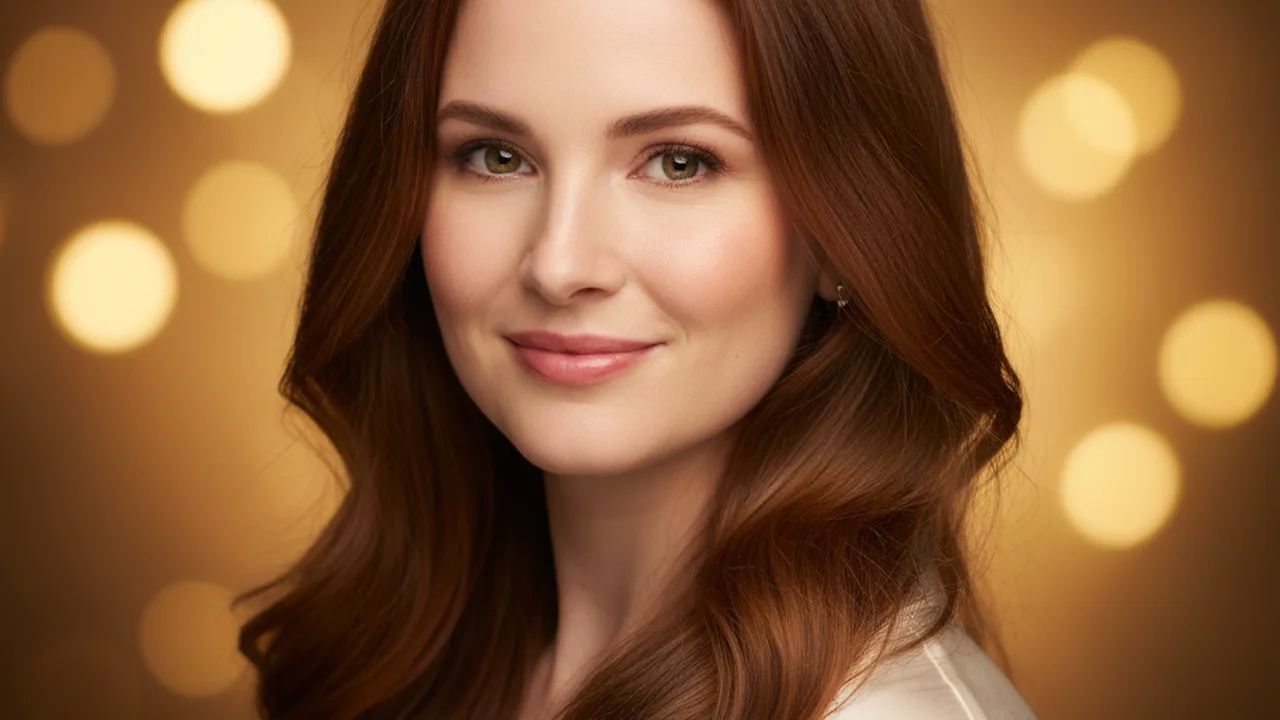
Your subject is perfectly posed, the light is gorgeous — and then the background steals the show. A busy parking lot, a cluttered living room, a tree branch growing out of someone’s head. The single fastest way to fix this? A dedicated portrait lens. The right optic isolates your subject with buttery background blur, flattering compression, and tack-sharp eye detail that no kit zoom can match.
Auf einen Blick: Your subject is perfectly posed, the light is gorgeous — and then the background steals the show. A busy parking lot, a cluttered living room, a tree branch growing out of someone’s head. The…
After testing dozens of primes and zooms across Canon RF, Sony E, Nikon Z, and Sigma Art systems, these are the best portrait lenses you can buy right now — organized by focal length, budget, and camera mount so you can find your perfect match in minutes.
• 85mm f/1.4–f/1.8 is the gold-standard portrait focal length for head-and-shoulders shots
• 50mm lenses are the best budget entry point — most cost under $250
• 135mm delivers the most dramatic background separation but needs more working distance
• Aperture matters more than brand — f/1.8 or wider is the portrait sweet spot
• Crop-sensor shooters should multiply by 1.5× (Nikon/Sony) or 1.6× (Canon) for equivalent field of view
Contents
- 1 Why Focal Length Matters for Portraits
- 2 Best 85mm Portrait Lenses (The Sweet Spot)
- 3 Best 50mm Portrait Lenses (Budget-Friendly)
- 4 Best 135mm Portrait Lens (Maximum Background Separation)
- 5 Portrait Lens Comparison Table
- 6 How to Choose the Right Portrait Lens for Your Style
- 7 Aperture and Bokeh Explained for Portrait Shooters
- 8 Crop Sensor vs Full Frame: What Changes?
- 9 Common Portrait Lens Mistakes to Avoid
- 10 Frequently Asked Questions
Why Focal Length Matters for Portraits
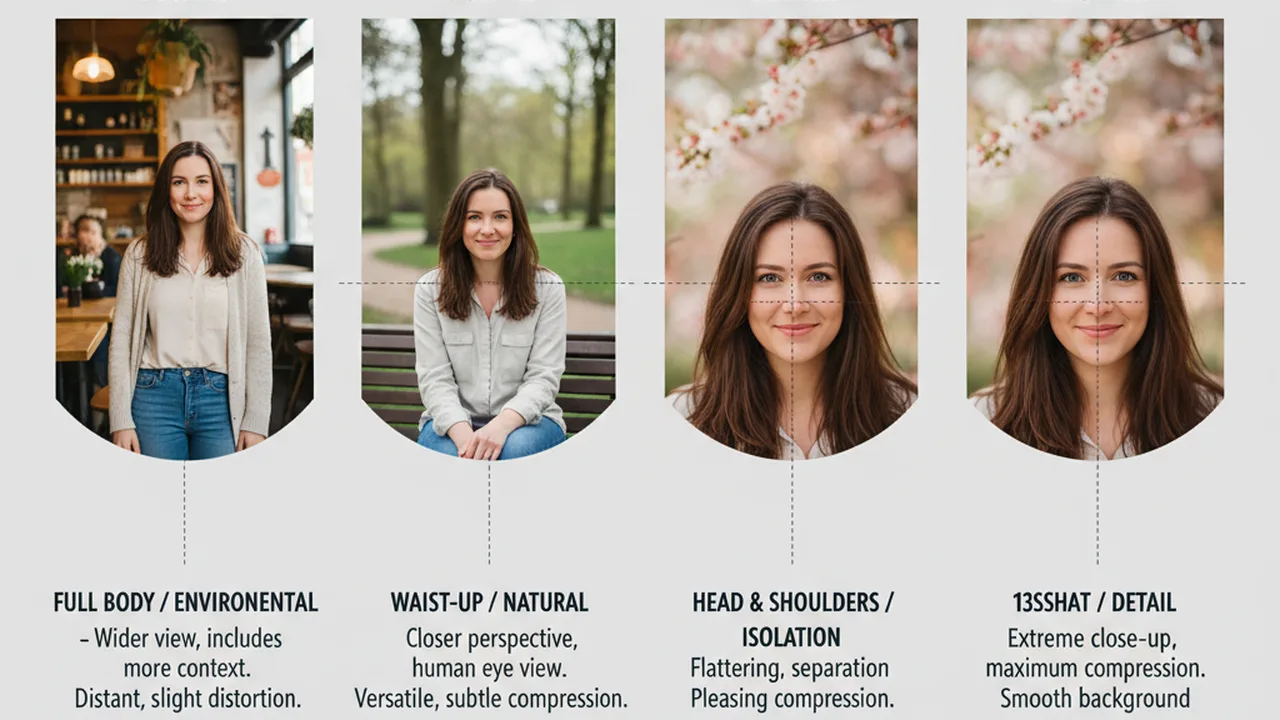
Focal length controls two things that directly shape how your subject looks: perspective distortion and background compression.
Shoot a headshot at 24mm and your subject’s nose looks enormous while their ears shrink. Move to 85mm and facial proportions flatten to something much closer to how we perceive people in real life. Push to 135mm or 200mm and backgrounds compress into smooth, abstract washes of color.
This isn’t just theory — it’s the reason professional headshot photographers overwhelmingly reach for lenses between 70mm and 135mm. That range delivers the most flattering facial proportions while keeping enough working distance (6–12 feet) that your subject doesn’t feel crowded.
| Focal Length | Best For | Background Blur | Working Distance |
|---|---|---|---|
| 35mm | Environmental portraits, storytelling | Moderate | 3–5 ft |
| 50mm | 3/4 body, street portraits | Good | 4–7 ft |
| 85mm | Headshots, upper body | Excellent | 6–10 ft |
| 105–135mm | Tight headshots, beauty work | Maximum | 8–15 ft |
| 70–200mm | Versatile — events to studio | Excellent (at 200mm) | Variable |
Best 85mm Portrait Lenses (The Sweet Spot)
If you only buy one portrait lens, make it an 85mm. This focal length has been the portrait photographer’s workhorse for decades because it delivers flattering compression without requiring a football field of working distance.
Canon RF 85mm f/2 Macro IS STM
Canon’s RF 85mm f/2 punches well above its weight. At roughly half the price of the RF 85mm f/1.2L, it delivers remarkably sharp portraits with a bonus: 0.5× macro capability that lets you shoot detail shots of jewelry, rings, or textures during the same session.
The built-in image stabilization (5 stops) is a genuine game-changer for handheld shooting in dimmer environments — church ceremonies, indoor receptions, golden hour sessions where you’re losing light fast. Autofocus is quick and nearly silent thanks to the STM motor, though it can hunt slightly in very low contrast scenes.
The f/2 maximum aperture means slightly less background blur than f/1.4 alternatives, but honestly, at portrait distances the difference is subtle. Most working photographers won’t notice unless they’re pixel-peeping side-by-side comparisons.
Sony FE 85mm f/1.8
Sony’s budget 85mm is one of the best value propositions in portrait photography. The optical quality rivals lenses costing three times as much — center sharpness at f/1.8 is outstanding, and the circular 9-blade aperture produces smooth, rounded bokeh that flatters every background.
At just 371g, it’s noticeably lighter than the GM version, which matters during long shooting sessions. Wedding photographers often prefer this over the heavier f/1.4 GM precisely because fatigue is real after 10 hours on your feet.
The trade-off? Autofocus speed is good but not class-leading, and there’s some minor longitudinal chromatic aberration (purple/green fringing) on high-contrast edges at f/1.8. Stopping down to f/2.2 eliminates this entirely.
Nikon Z 85mm f/1.8 S
Nikon’s Z-mount 85mm is arguably the sharpest 85mm lens under $1,000. The S-line optical design resolves extraordinary detail even wide open — eyelashes, skin texture, individual hair strands all render with surgical precision.
What sets this lens apart is its bokeh character. Nikon specifically engineered the optical formula to eliminate onion-ring patterns in out-of-focus highlights, producing clean, creamy circles that rival much more expensive alternatives. The multi-focus system also means autofocus is fast, accurate, and nearly silent.
One consideration: there’s no image stabilization in the lens itself (Nikon relies on IBIS in the Z-mount bodies). If you’re shooting a Z50 or Zfc without IBIS, you’ll need faster shutter speeds in low light.
Sigma 85mm f/1.4 DG DN Art
The Sigma Art 85mm is the enthusiast’s dream — f/1.4 aperture, Art-series optical quality, and compatibility with both Sony E-mount and L-mount systems at a fraction of what first-party f/1.4 lenses cost.
Wide open at f/1.4, the depth of field is razor-thin. Focus on the near eye and the far ear is already dissolving into blur. This creates that dramatic, three-dimensional look that portrait photographers chase, but it also demands precise focusing technique. Eye-AF is practically mandatory here.
Build quality is excellent — metal construction, weather sealing, and a smooth manual focus ring with just the right amount of resistance. The 625g weight sits between the lighter f/1.8 options and the heavier first-party f/1.2 lenses.
Best 50mm Portrait Lenses (Budget-Friendly)
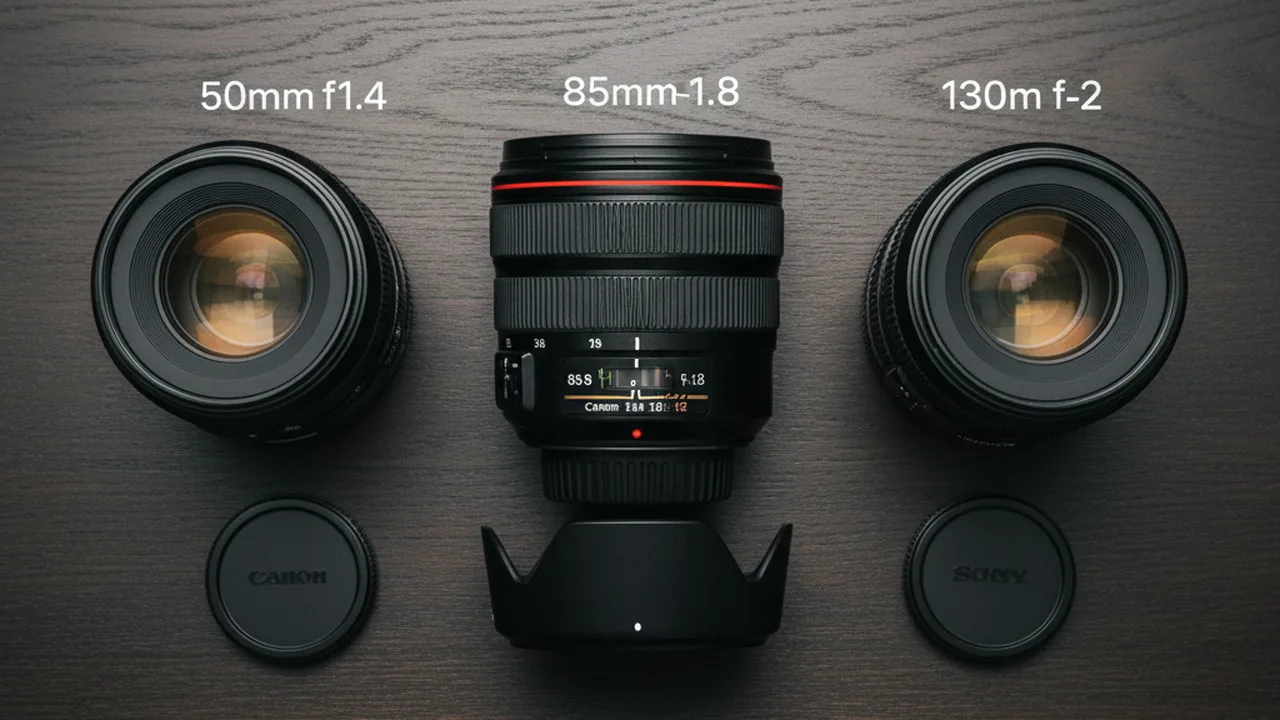
The 50mm focal length is where every portrait photographer should start. These lenses are affordable, lightweight, and versatile enough to handle portraits, street photography, and everyday shooting. On a crop-sensor body, a 50mm gives you an effective 75–80mm — surprisingly close to the classic portrait perspective.
Canon RF 50mm f/1.8 STM
Canon’s “nifty fifty” for the RF mount costs less than a nice dinner for two and delivers results that genuinely surprise people. Sharpness at f/2.8 rivals professional L-series glass, and even wide open at f/1.8, the center is crisp enough for portrait work.
The plastic build won’t win durability awards, and the STM autofocus motor is adequate rather than blazing — but for the price, nothing else comes close. This is the lens that teaches you why prime lenses matter.
Nikon Z 50mm f/1.8 S
Nikon’s Z 50mm f/1.8 S is not your typical budget fifty. It’s an S-line lens with optical performance that embarrasses some lenses costing twice as much. Resolution is exceptional from edge to edge, even at f/1.8, and the bokeh is beautifully smooth with no harsh double-line outlines.
For portrait work, this lens excels at three-quarter and full-body shots where you want environmental context without sacrificing subject separation. It’s also compact enough at 415g to leave on your camera all day as a general-purpose walkaround lens that happens to shoot stunning portraits.
Best 135mm Portrait Lens (Maximum Background Separation)
Sony FE 135mm f/1.8 GM
If background separation is your obsession, the Sony 135mm GM is the ultimate portrait weapon. The combination of 135mm focal length and f/1.8 aperture produces background blur so intense that even a chain-link fence 15 feet behind your subject dissolves into a smooth gradient.
Sharpness is otherworldly. This lens resolves more detail than most camera sensors can capture, making it future-proof for higher-resolution bodies. The XD linear motors deliver autofocus that’s both fast and deadly accurate — critical when your depth of field at f/1.8 measures in millimeters.
The catch? You need space. For a headshot, you’ll be standing 10–15 feet from your subject. Tight indoor locations simply don’t work with this lens. And at 950g, it’s not something you’ll forget is hanging from your neck.
Portrait Lens Comparison Table
| Lens | Mount | Aperture | Weight | Best For |
|---|---|---|---|---|
| Canon RF 85mm f/2 Macro IS STM | Canon RF | f/2 | 500g | Versatile portraits + macro |
| Sony FE 85mm f/1.8 | Sony E | f/1.8 | 371g | Best value 85mm |
| Nikon Z 85mm f/1.8 S | Nikon Z | f/1.8 | 470g | Sharpest under $1K |
| Sigma 85mm f/1.4 DG DN Art | Sony E / L | f/1.4 | 625g | Best f/1.4 value |
| Canon RF 50mm f/1.8 STM | Canon RF | f/1.8 | 160g | Budget starter |
| Nikon Z 50mm f/1.8 S | Nikon Z | f/1.8 | 415g | Premium 50mm |
| Sony FE 135mm f/1.8 GM | Sony E | f/1.8 | 950g | Maximum bokeh |
How to Choose the Right Portrait Lens for Your Style
Picking a portrait lens comes down to three honest questions about how you actually shoot.
Where Do You Shoot?
Small home studios and indoor locations demand shorter focal lengths. An 85mm in a 10×12 foot room only gives you a tight headshot — you physically can’t back up far enough for anything wider. A 50mm gives you breathing room for three-quarter and full-body compositions in the same space.
Outdoor sessions and larger studios open up the 85mm and 135mm options. Parks, urban streets, and open fields give you unlimited working distance, so you can take full advantage of the background compression and blur that longer focal lengths provide.
What Do You Shoot?
Headshots and beauty: 85mm or 135mm. The compression flatters facial features, and the narrow field of view makes background control effortless.
Environmental portraits: 35mm or 50mm. You want context — the workshop, the kitchen, the studio — framing your subject within their world.
Events and weddings: 70–200mm f/2.8 zoom or a fast 85mm prime. Events demand flexibility because you can’t always control your distance from the subject.
What’s Your Budget?
Portrait lenses span from under $150 to over $2,500. The good news: the biggest image quality jump happens at the bottom of the price range. Going from a kit zoom to even a $200 50mm f/1.8 prime transforms your portrait photography more dramatically than upgrading from a $600 lens to a $2,000 one.
Aperture and Bokeh Explained for Portrait Shooters
Aperture — that f-number on your lens — controls how much of your image is in sharp focus. For portraits, wider apertures (lower f-numbers) are almost always better because they blur the background and make your subject pop.

Here’s what the numbers actually mean in practice:
f/1.2–f/1.4: Ultra-shallow depth of field. At portrait distances, the in-focus zone is measured in inches. One eye can be sharp while the other starts to soften. Dramatic and beautiful, but technically demanding — you need precise autofocus and a steady hand.
f/1.8–f/2: The sweet spot for most portrait photographers. Enough blur to separate subject from background while keeping both eyes comfortably in focus for headshots. This is where the majority of professional portrait work happens.
f/2.8: Good subject separation with more forgiving focus accuracy. Many zoom lenses max out here, and it’s perfectly workable for portraits — especially at longer focal lengths like 200mm where the compression already blurs backgrounds significantly.
Bokeh quality matters as much as bokeh quantity. A lens with smooth, circular bokeh turns distracting backgrounds into pleasant, creamy washes. A lens with harsh, outlined, or “nervous” bokeh can make backgrounds look busy even when blurred. This is where premium lenses justify their price — the optical design specifically targets beautiful out-of-focus rendering.
Crop Sensor vs Full Frame: What Changes?
If you’re shooting an APS-C body (Canon R7, Sony a6700, Nikon Z50, Fujifilm X-series), your sensor’s crop factor changes the effective field of view of every lens.
A 50mm lens on a 1.5× crop sensor (Sony, Nikon, Fuji) frames like a 75mm on full frame — actually a fantastic portrait perspective. That same 50mm on Canon’s 1.6× crop frames like an 80mm, even closer to the ideal portrait range.
An 85mm on crop sensor frames like 127–136mm, which is excellent for tight headshots but limits your ability to shoot wider compositions. In small spaces, this can become restrictive.
Practical recommendation for crop sensor shooters: Start with a 35mm f/1.4 (gives you ~52mm equivalent) or a 50mm f/1.8 (gives you ~75mm equivalent). Both sit perfectly in the portrait sweet spot on APS-C bodies.
Common Portrait Lens Mistakes to Avoid
Shooting wide open for every frame. Just because your lens opens to f/1.4 doesn’t mean you should stay there. For group portraits, f/4–f/5.6 keeps everyone sharp. For individual portraits, f/2–f/2.8 often produces better results than f/1.4 because more of the face stays in the focus plane.
Ignoring autofocus accuracy. A portrait with the focus on the nose instead of the eyes is a failed portrait, regardless of how beautiful the bokeh is. Use single-point AF locked onto the near eye, and enable Eye-AF if your camera supports it.
Buying the most expensive option first. The $200 Canon RF 50mm f/1.8 teaches you everything about portrait photography that the $2,800 RF 85mm f/1.2L does — minus a half-stop of light and some bokeh refinement. Start affordable, learn what you actually need, then upgrade with purpose.
Neglecting light for lens quality. A $150 lens in beautiful window light produces better portraits than a $2,000 lens under harsh overhead fluorescents. Master lighting first — the lens is the second variable.
Frequently Asked Questions
Explore our complete guides to Field of View Calculator and DPI Calculator to plan your perfect portrait session.
Explore More Photography Guides
Find the perfect gear and techniques for your next shoot.