You’re standing at a waterfall on a bright afternoon, camera on a tripod, and you want that dreamy, silky water effect you’ve seen in landscape magazines. You set the shutter speed to 2 seconds — and the image comes back completely white. An ND filter would have saved that shot. Neutral density filters are one of the most practical tools in photography, yet many photographers either skip them entirely or buy the wrong ones. This guide covers exactly what ND filters do, which strengths you actually need, and how to use them for sharper, more creative images.
Auf einen Blick: You’re standing at a waterfall on a bright afternoon, camera on a tripod, and you want that dreamy, silky water effect you’ve seen in landscape magazines. You set the shutter speed to 2…
🔑 Key Takeaways
- ND filters reduce light entering the lens without changing color — like sunglasses for your camera
- 3-stop, 6-stop, and 10-stop are the three most useful strengths for 90% of photography
- Circular screw-on filters are easiest for beginners; square systems offer more flexibility
- Long exposure, motion blur, and wide aperture in bright light are the three core use cases
Contents
- 1 What Is an ND Filter and How Does It Work?
- 2 ND Filter Strengths Explained
- 3 When to Use an ND Filter: 5 Real Scenarios
- 4 Types of ND Filters: Screw-On vs. Square
- 5 Variable ND Filters: Convenient but Compromised
- 6 How to Shoot with an ND Filter: Step-by-Step
- 7 Common ND Filter Mistakes to Avoid
- 8 Graduated ND Filters: Handling Bright Skies
- 9 ND Filters for Different Photography Styles
- 10 Frequently Asked Questions
- 11 Building Your ND Filter Kit
- 12 Recommended ND Filters
- 13 Final Thoughts
What Is an ND Filter and How Does It Work?
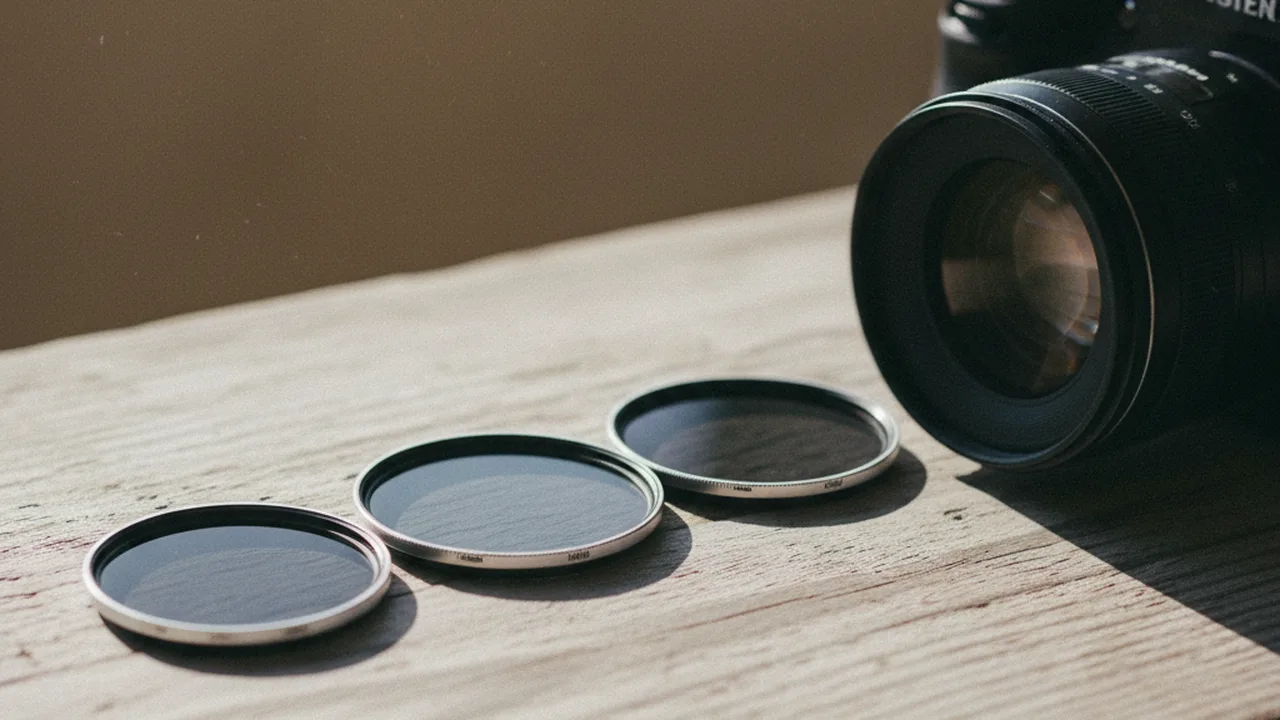
A neutral density filter is a piece of darkened glass (or resin) that attaches to the front of your lens. Its only job is to reduce the amount of light reaching the sensor — without shifting colors or adding any tint. Think of it as controlled darkness.
The “neutral” part is critical. Unlike a polarizing filter that changes reflections, or a color filter that shifts white balance, a properly made ND filter should make the image darker and nothing else.
Why not just use a smaller aperture? Two reasons. First, most lenses lose sharpness beyond f/11 or f/16 due to diffraction — the physics of light bending around very small aperture blades. Second, a smaller aperture also increases depth of field, which you might not want. An ND filter lets you control exposure independently of aperture and ISO.
ND Filter Strengths Explained
ND filters are rated by how many stops of light they block. One stop halves the light. The naming conventions are notoriously confusing — the same filter might be labeled three different ways depending on the manufacturer. Here’s the decoder ring:
| Stops | ND Number | Optical Density | Light Reduction | Best For |
|---|---|---|---|---|
| 1 stop | ND2 | 0.3 | 50% | Subtle motion blur |
| 2 stops | ND4 | 0.6 | 75% | Wider aperture in sun |
| 3 stops | ND8 | 0.9 | 87.5% | Moving water, clouds |
| 6 stops | ND64 | 1.8 | 98.4% | Smooth water, crowd removal |
| 10 stops | ND1000 | 3.0 | 99.9% | Ultra-long exposure, daytime 30s+ |
| 15 stops | ND32768 | 4.5 | 99.997% | Extreme daytime long exposure |
The sweet spot for most photographers: a 6-stop and a 10-stop filter. Stack them for 16 stops when you need multi-minute exposures in daylight. A 3-stop is useful if you shoot video or portraits in bright conditions.
When to Use an ND Filter: 5 Real Scenarios
1. Silky Waterfalls and Streams
This is the classic ND filter application. A shutter speed between 0.5 and 8 seconds turns turbulent water into a smooth, flowing texture. Without an ND filter on a sunny day, you’d need f/22 and ISO 50 to get even 1/4 second — and the image would be soft from diffraction.
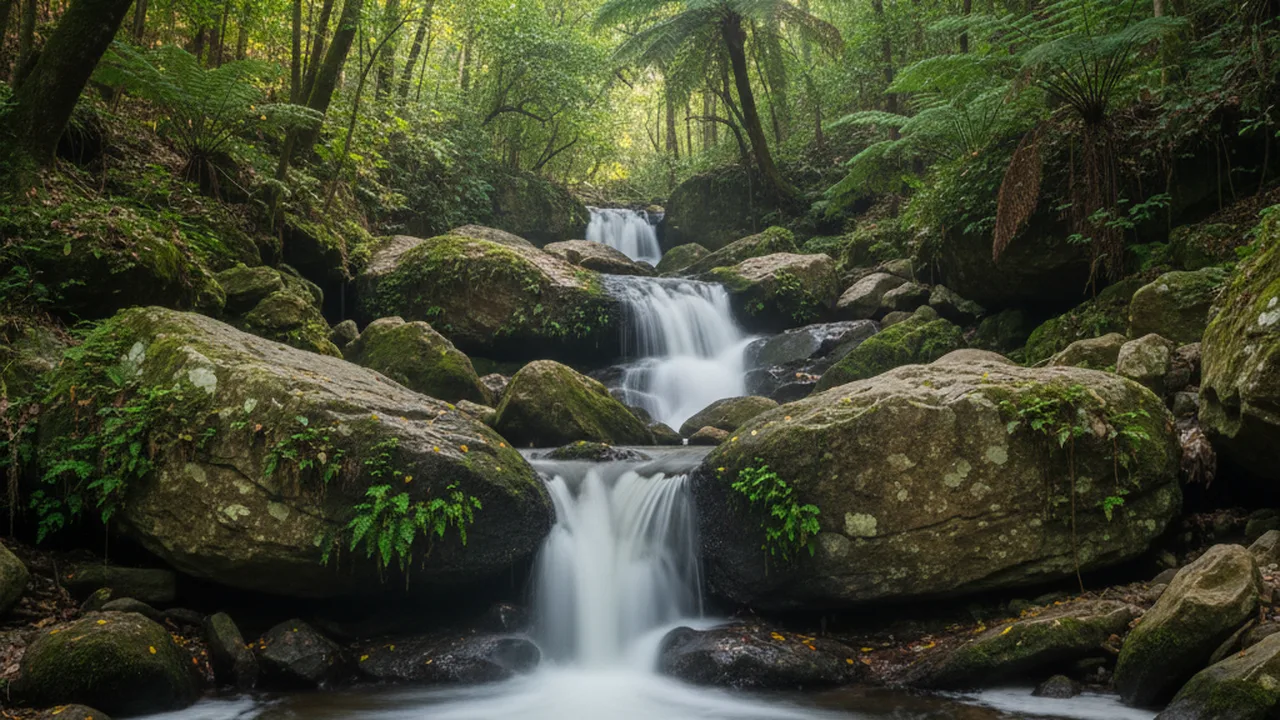
Recommended filter: 6-stop ND64 in overcast conditions, 10-stop ND1000 in full sun. Set your camera to aperture priority at f/8–f/11, attach the filter, and let the camera calculate the longer shutter speed. Switch to manual if the metering struggles.
2. Smoothing Ocean Waves
Exposures of 15–30 seconds flatten waves into a misty, ethereal surface. At 1–4 minutes, the ocean becomes a flat mirror with fog-like atmosphere. This effect transforms busy seascapes into minimalist compositions — particularly powerful at sunrise and sunset when the warm light blends with the smooth water.
3. Removing Crowds from Tourist Spots
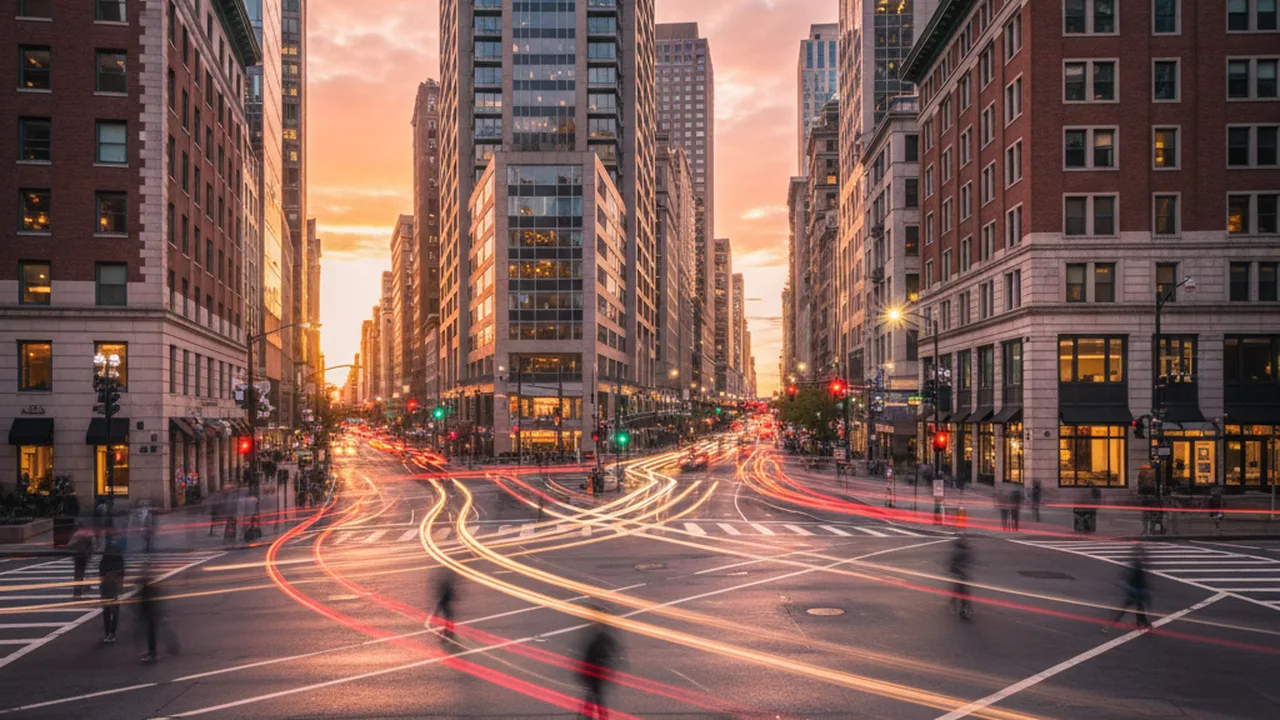
A 10-stop ND filter lets you shoot 30-second to 2-minute exposures in broad daylight. Since people move through the scene, they become transparent ghosts — or disappear entirely. This technique works at landmarks, plazas, and busy streets. The key requirement: your subject (the building, monument, or landscape) must be completely still.
4. Wide Aperture Portraits in Bright Sun
You want f/1.4 bokeh for a portrait, but it’s noon and sunny. Even at ISO 100, your fastest shutter speed of 1/8000s might not be enough. A 3-stop ND8 filter brings the exposure down to 1/1000s at f/1.4 in full sun — perfectly manageable.

Portrait and wedding photographers who shoot wide-open primes in daylight often carry a 2 or 3-stop ND filter specifically for this purpose.
5. Video with Cinematic Motion Blur
The 180-degree shutter rule for video means your shutter speed should be double your frame rate — 1/50s for 24fps, 1/60s for 30fps. Outdoors in sunlight, even f/8 and ISO 100 won’t get you to 1/50s. A 3-stop to 6-stop ND filter is essentially mandatory for outdoor video work with proper motion blur.
Types of ND Filters: Screw-On vs. Square
There are two physical formats, and each has genuine trade-offs:
| Feature | Screw-On (Circular) | Square/Rectangular |
|---|---|---|
| Convenience | Fast to attach/remove | Requires holder + adapter rings |
| Lens compatibility | One size per lens thread | One filter fits all lenses (with adapter) |
| Graduated ND | Fixed position — limited use | Slide up/down to position the transition |
| Stacking | Can cause vignetting | Stacks cleanly in holder slots |
| Price entry point | $20–80 per filter | $100–300+ for holder + filters |
| Best for | Beginners, travel, video | Landscape pros, GND work |
Practical advice: Start with screw-on filters in the thread size of your most-used lens (often 67mm or 77mm). Buy a step-up ring if you have lenses with different thread sizes — attach the larger filter to the smaller lens using the adapter. If you later get serious about landscape work with graduated NDs, invest in a 100mm square system.
Variable ND Filters: Convenient but Compromised
Variable ND filters use two polarizing layers that rotate against each other. Turning the front ring adjusts the darkness from roughly 2 to 8 stops. Sounds ideal — one filter to replace several. The reality is more nuanced.
The cross-pattern problem: At high densities (above ~5 stops), most variable NDs produce an ugly X-shaped dark pattern across the image. This is caused by the polarizing layers reaching near-extinction angles. Cheap variable NDs show this artifact starting at just 3-4 stops.
When variable NDs make sense: Video shooters who need to adjust exposure on the fly benefit most. For stills photography where you can take time to swap fixed filters, dedicated ND filters will always deliver better optical quality.
How to Shoot with an ND Filter: Step-by-Step
Step 1: Compose and focus without the filter. With a 10-stop ND attached, your viewfinder goes nearly black. Autofocus won’t work. Set up your shot first, lock focus (switch lens to MF), then attach the filter.
Step 2: Calculate the new shutter speed. Each stop doubles the exposure time. If your unfiltered exposure is 1/125s at f/11:
- With a 3-stop ND8: 1/125 → 1/60 → 1/30 → 1/15s
- With a 6-stop ND64: 1/125 → 1/60 → 1/30 → 1/15 → 1/8 → 1/4 → 1/2s
- With a 10-stop ND1000: 1/125 → … → 8 seconds
Step 3: Switch to Manual or Bulb mode. For exposures under 30 seconds, Manual mode works. For longer exposures, use Bulb mode with a remote shutter release or your camera’s built-in timer app.
Step 4: Cover the viewfinder. On DSLRs, light leaking through the optical viewfinder during long exposures creates purple streaks. Use the eyepiece cover that came with your camera (often attached to the strap) or cover it with your hand. Mirrorless cameras don’t have this issue.
Step 5: Enable Long Exposure Noise Reduction for exposures over 1 second. This doubles the capture time (the camera takes a “dark frame” to subtract hot pixel noise) but significantly improves image quality.
Common ND Filter Mistakes to Avoid
Buying the cheapest filter you can find. A $15 ND filter on a $2,000 lens defeats the purpose. Low-quality glass introduces color casts (usually warm brown or magenta), reduces contrast, and can cause ghosting. Budget filters from reputable brands (like Hoya’s Pro ND line) start around $30-40 and are noticeably better than no-name alternatives.
Forgetting to remove the UV or clear filter first. Stacking an ND on top of a UV filter doubles the glass surfaces, increasing the risk of flare and ghosting. If you use a protective filter, remove it before adding the ND.
Not using a tripod. Any exposure longer than about 1/15s will show camera shake with handheld shooting. If you’re using an ND filter for long exposures, a tripod is not optional — it’s required. Even image stabilization can’t compensate for 2-second exposures.
Leaving image stabilization on during tripod use. Counterintuitively, IS/VR/IBIS can introduce vibration when the camera is already perfectly still on a tripod. Turn it off for any tripod-based ND filter work.
Not checking for color casts. Even good ND filters may have a slight color shift. Shoot a test frame with and without the filter, then compare in Lightroom. If there’s a cast, note the white balance offset (e.g., +300K and +5 tint) and apply it as a correction preset for that filter.
Graduated ND Filters: Handling Bright Skies
Graduated ND (GND) filters are dark on top and clear on the bottom, designed to darken a bright sky while leaving the foreground properly exposed. They come in three transition styles:
- Hard-edge GND: Sharp transition line. Best for flat horizons (ocean, plains)
- Soft-edge GND: Gradual transition. Works with uneven horizons (mountains, trees, buildings)
- Reverse GND: Darkest at the center horizon, lighter toward the top. Purpose-built for sunsets where the brightest area is the horizon itself
Are GND filters still necessary in 2026? Modern cameras with 14+ stops of dynamic range (Sony A7R V, Nikon Z8, Canon R5 II) can often recover 3-4 stops from a single RAW file through shadow/highlight recovery. For scenes within that range, exposure bracketing or a single well-exposed RAW may be sufficient. But for extreme dynamic range scenes — sun at the horizon, backlit landscapes with 8+ stop differences — a GND filter still reduces noise and preserves shadow detail better than post-processing recovery.
ND Filters for Different Photography Styles
| Photography Style | Recommended ND | Typical Exposure |
|---|---|---|
| Waterfall / river | 6-stop ND64 | 0.5–8 seconds |
| Ocean / seascape | 10-stop ND1000 | 30s–4 minutes |
| Cloud movement | 10-stop ND1000 | 2–5 minutes |
| Crowd removal | 10-stop ND1000 | 30s–2 minutes |
| Portrait in sun | 3-stop ND8 | 1/500–1/2000s |
| Video (24fps outdoor) | 3–6 stop (or variable) | 1/50s fixed |
| Sunrise/sunset landscapes | 3-stop GND + 6-stop ND | 1–15 seconds |
Frequently Asked Questions
Can I use an ND filter at night?
Technically yes, but there’s rarely a reason to. At night, you already have low light — the challenge is getting enough exposure, not reducing it. The exception is shooting near very bright artificial light sources (like neon signs or stadium lights) where you want motion blur but the lights are overpowering the scene.
Do ND filters affect autofocus?
Light ND filters (1-3 stops) generally don’t interfere with autofocus on modern cameras. Strong ND filters (6-10 stops) reduce so much light that autofocus slows down dramatically or fails entirely. Always focus before attaching a strong ND filter, then switch your lens to manual focus to lock it.
What size ND filter should I buy first?
Buy the filter size that matches your largest lens thread diameter, then use step-up adapter rings for your smaller lenses. For example, if you own a 67mm and a 77mm lens, buy the 77mm ND filter and a 67-77mm step-up ring. This way one filter works for both lenses.
Are cheap ND filters worth it?
Budget ND filters under $20 almost always introduce color casts — usually a warm brown or magenta tint that’s difficult to fully correct in post. They also tend to reduce sharpness and contrast. Mid-range filters from brands like Hoya, K&F Concept, or NiSi ($30-60) offer dramatically better optical quality and are the minimum recommended investment.
Can I stack multiple ND filters?
Yes — stacking a 6-stop and 10-stop gives you 16 stops of reduction. However, stacking increases the risk of vignetting (dark corners), especially on wide-angle lenses below 24mm. It also adds glass surfaces that can cause ghosting and flare. Use slim-profile filters to minimize vignetting, and avoid stacking more than two filters.
Building Your ND Filter Kit
If you’re starting from zero, here’s a practical buying order:
First filter: 6-stop ND64 in your most-used thread size. This is the most versatile single ND filter — enough for silky water in overcast conditions, video work, and moderate long exposures.
Second filter: 10-stop ND1000. This unlocks ultra-long exposures in daylight: smooth oceans, cloud streaks, crowd removal.
Third filter (if you shoot video or portraits): 3-stop ND8 or a quality variable ND. The 3-stop handles wide-aperture portraiture in bright sun. The variable ND is ideal for video where you need exposure adjustments between takes.
Optional upgrade: A 100mm square filter system with holder, if you shoot landscapes seriously and want graduated ND capability with precise positioning.
Recommended ND Filters
Based on the filter strengths and use cases covered above, here are three top-rated ND filters that deliver excellent optical quality at different price points. All are 77mm — the most common pro lens thread size — and can be adapted to smaller lenses with a step-up ring.
🏆 B+W 77mm Master ND 3.0
10-Stop | MRC Nano Coating | Schott Glass
The gold standard for 10-stop ND filters. B+W’s Master series uses premium Schott glass with multi-resistant nano coating that repels water, dust, and fingerprints. Virtually zero color cast — critical for long exposures where even slight tints multiply.
⭐ Hoya PRO ND-EX ND1000 77mm
10-Stop | ACCU-ND Coating | Low Profile Frame
Hoya’s latest ND-EX line delivers consistent neutral density with their ACCU-ND technology. The low-profile aluminum frame minimizes vignetting on wide-angle lenses — a common issue with thicker 10-stop filters. Excellent value for the quality.
💰 Kenko PRO ND8 77mm
3-Stop | Multi-Coated | Budget-Friendly
A reliable 3-stop filter for portraits in bright sun, video work, and subtle motion blur. Kenko’s multi-coating reduces reflections while maintaining sharpness. At this price point, it’s the easiest way to start experimenting with ND filters.
As an Amazon Associate, we earn from qualifying purchases. This doesn’t affect our recommendations — we only suggest products we’d use ourselves.
Final Thoughts
An ND filter is one of the few camera accessories that genuinely creates shots you cannot get any other way. No amount of post-processing can turn a 1/500s exposure into a 30-second long exposure. No Photoshop trick perfectly replicates the smooth water and streaked clouds of a real long exposure shot in-camera. For the cost of a moderately priced lens filter, you unlock an entire category of creative photography that’s impossible without one.
Start with a 6-stop, take it to the nearest stream or coast, and spend an afternoon experimenting with different shutter speeds. The results will make the purpose of every number in this guide click into place.
📸 Explore More Photography Guides
From camera settings to gear reviews — learn techniques that improve your images.
Explore More Photography Guides
Find the perfect gear and techniques for your next shoot.
Related guides: Milky Way Photography Guide | Best Portrait Lenses 2026 | Best Cameras for Beginners